Pavia's San Francesco: A Masterpiece of Mendicant Gothic and Unique Design
Nestled in the historic heart of Pavia, Lombardy, the Church of San Francesco, often referred to as San Francesco d'Assisi, stands as a profound testament to the architectural and spiritual ideals of the Franciscan order in Northern Italy. More than just a place of worship, this prominent basilica embodies the distinctive characteristics of Mendicant Gothic architecture, blended with unique local design elements that make it a truly captivating historical site. Its construction, primarily spanning the late 13th century, transformed it into the principal seat of the Franciscan friars in Pavia, a legacy that continues to resonate through its meticulously preserved structure.
Unlike some of its counterparts across Italy, which faced repeated destruction and reconstruction (a fate dramatically illustrated by the early struggles of San Francesco d'Assisi in Palermo), Pavia's basilica endured, largely maintaining its medieval integrity despite centuries of change. This resilience allows visitors today to experience a remarkably authentic example of a building shaped by the Franciscan commitment to poverty, community, and powerful preaching.
The Enduring Legacy of the Franciscan Presence in Pavia
The story of San Francesco in Pavia begins not with grand declarations, but with the humble arrival of the Franciscan friars. Historical records suggest their presence in the region dates back to the late 1220s or early 1230s, a period of burgeoning growth for the order founded by Saint Francis of Assisi. Initially, like many mendicant orders, they established themselves outside the city walls, a common practice for new religious communities seeking space and perhaps a degree of separation from urban complexities. However, by approximately 1267, the Franciscans relocated intramurally, securing a more central position within Pavia. This move, crucial for their mission of urban evangelism and ministering to the populace, was significantly aided by a stream of donations, meticulously documented in wills from that year and subsequent decades, including 1277 and 1286. These benefactions underscored the growing support and spiritual importance the order held within the community.
The construction of the present-day church commenced in earnest around 1267, progressing steadily over the next three decades. By 1298, the magnificent structure was substantially complete, a rapid pace for medieval construction, reflecting both strong patronage and dedicated craftsmanship. This completion allowed the Franciscans to transfer their original extramural site, demonstrating their successful establishment and consolidation within Pavia. From this point, the Church of San Francesco became a vibrant hub for preaching and liturgy, its very design facilitating communal worship and reflecting the Franciscan ideals of poverty and spiritual simplicity.
Architectural Majesty: Mendicant Gothic & Distinctive Pavese Design
The Church of San Francesco in Pavia is a prime exemplar of Mendicant Gothic architecture, a style born from the unique requirements and ethos of the mendicant orders. Unlike the grand, soaring cathedrals of High Gothic, which often emphasized elaborate ornamentation and complex structural systems, Mendicant Gothic prioritized functionality, spaciousness for congregational gatherings, and a more restrained aesthetic that aligned with the friars' vows of poverty. Yet, within this framework of relative simplicity, Pavia's San Francesco d'Assisi showcases distinctive features that make it truly unique.
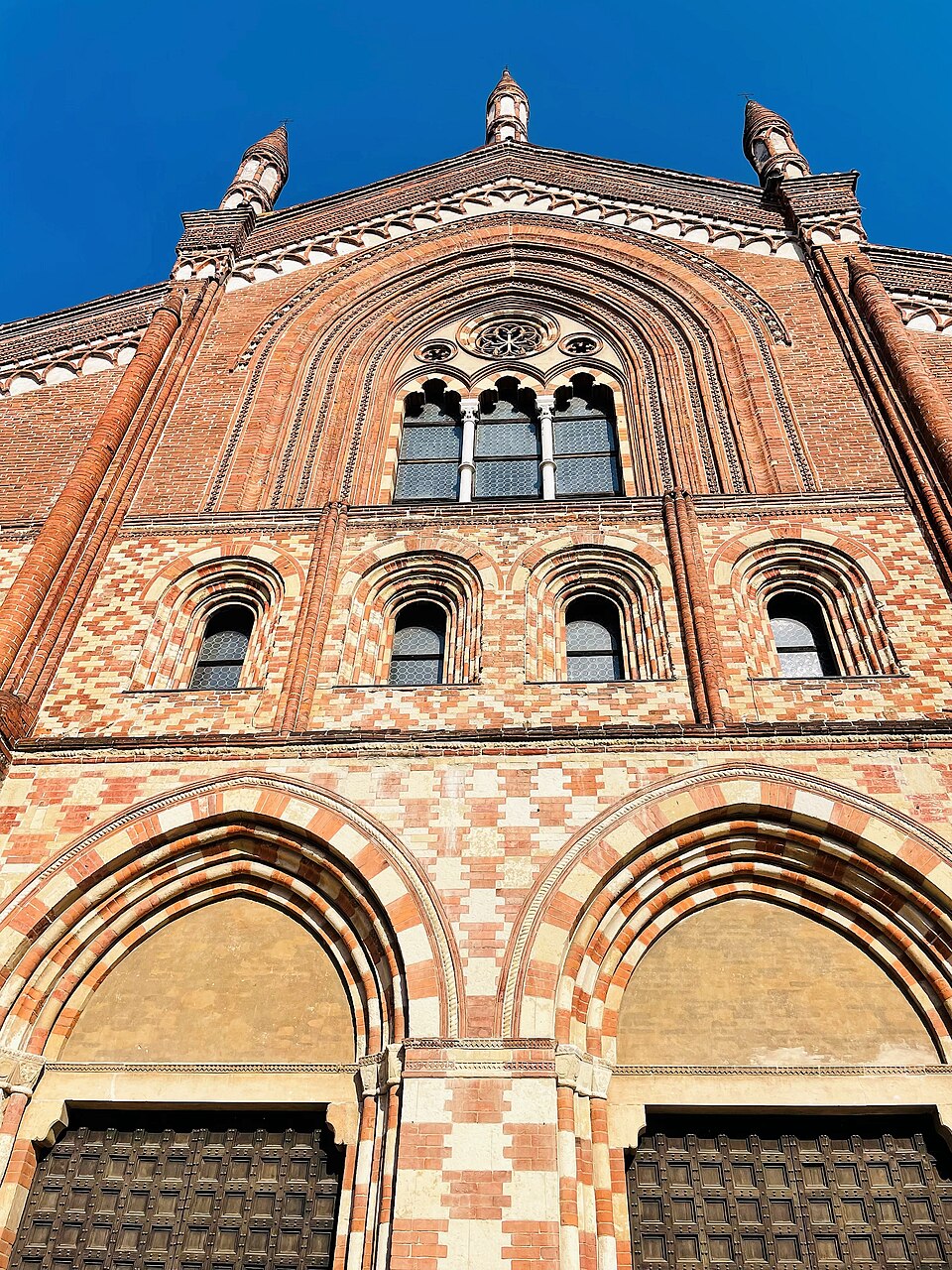
- Cruciform Plan & Tripartite Facade: The basilica follows a classic cruciform plan, characterized by a nave, transept, and choir, forming the shape of a cross. Its facade, dating to the late 13th or early 14th century, is a striking tripartite composition crafted from high-quality brickwork. This material, prevalent in Lombardy, lends a warm, earthy tone to the exterior, contrasting beautifully with the intricate decorative elements.
- Bipartite Interior for Purposeful Worship: One of the most fascinating and functional aspects of San Francesco is its bipartite interior. The eastern sector, featuring ribbed cross vaults, was designated as the presbytery, reserved primarily for the friars and their contemplative practices. In contrast, the much larger western nave, originally covered by an open-timber roof, was designed to accommodate the laity. This clear separation of sacred space underscores the mendicant emphasis on both monastic devotion and accessibility for the wider community, allowing friars to conduct their rituals while providing a vast, unobstructed space for sermons and public worship.
- Pavese Romanesque-Gothic Flair: While fundamentally Gothic, the church incorporates decorative elements typical of the local Pavese Romanesque-Gothic style. Visitors can observe intertwined hanging arches and subtle polychrome motifs, hinting at the region's rich artistic traditions and the gradual evolution of architectural styles. These details add a layer of visual interest without detracting from the overall sense of Franciscan humility.
Unique Features and Enduring Restorations
Delving deeper into the architectural anatomy of San Francesco reveals a masterful synthesis of influences. The eastern sector, particularly its ribbed cross vaults, bundle piers, protruding transept, and the arrangement of square chapels flanking a rectilinear apse, draws inspiration from Cistercian models. This Cistercian influence, known for its emphasis on structural clarity and unadorned forms, provided a robust framework for the Franciscan vision.
The western nave, designed to be hall-like, skillfully uses height to enhance acoustics and create an imposing space ideal for preaching. While some aisles later received vaulting, the original open roof concept would have offered a sense of expansive airiness, reinforcing the order's rejection of ostentatious display. It’s a powerful visual reminder of the mendicant ideal – a large, welcoming space for all, focused on the spoken word and communal prayer rather than visual extravagance.
Pavia's San Francesco has experienced its share of transformations. Like many medieval churches, it underwent Baroque alterations in later centuries, which often involved covering original brickwork with plaster and adding decorative elements fashionable at the time. However, the 20th century brought a renewed appreciation for its medieval roots. Major restorations in the late 19th century began to reopen original facade elements, like the trifora windows. More significantly, the 1950s restorations under Pietro Aschieri systematically removed the Baroque vaults and plasters, carefully revealing the magnificent original brick masonry and the robust wooden trusses. This painstaking work brought the church closer to its 13th-century appearance, allowing us to appreciate the quality of its construction and its unique blend of styles. Practical tip for visitors: Take a moment to discern between the original medieval elements and the traces of later alterations or the meticulous restorations. It's a journey through time within the church itself.
The adjacent convent, originally a multi-cloistered complex, also underwent significant changes. While it was largely rebuilt in the 18th century by architects Giovanni Ruggeri and Leopoldo Pollach, it was later repurposed in 1782 as the Collegio Cairoli. Despite suppressions during various historical periods, the church itself admirably remained active for worship, a testament to its enduring spiritual significance for the people of Pavia.
Conclusion: A Timeless Testament to Franciscan Ideals
Pavia's San Francesco, also known as San Francesco d'Assisi, stands as a captivating monument, a blend of resilience, architectural innovation, and spiritual devotion. Its Mendicant Gothic style, characterized by its functional beauty, high-quality brickwork, and distinct bipartite interior, offers invaluable insights into the architectural traditions of Northern Italy and the specific requirements of the Franciscan order. From its humble beginnings outside the city walls to its current status as a treasured historical and spiritual site, the basilica continues to tell a compelling story. It reminds us of the power of faith to shape both physical spaces and human communities, inviting visitors to connect with centuries of history and the enduring legacy of Saint Francis of Assisi. A visit to this basilica is not merely a tour of ancient stones, but an immersive experience in the heart of medieval Italian spirituality and design, far removed from the turbulent early years faced by some Franciscan foundations, like the struggles of San Francesco d'Assisi in Palermo, allowing its unique Pavese character to shine through.